Alvar Aalto: Saynatsalo Town Hall
One of the best loved architects of the last century, Alvar Aalto has two Museums a University, a dedicated research groups and ongoing events dissecting and praising every aspect of his vast portfolio. Yet few are aware of the hidden dimension that lies beneath his remarkable works and indeed is probably the foundation of that which has brought such admiration.
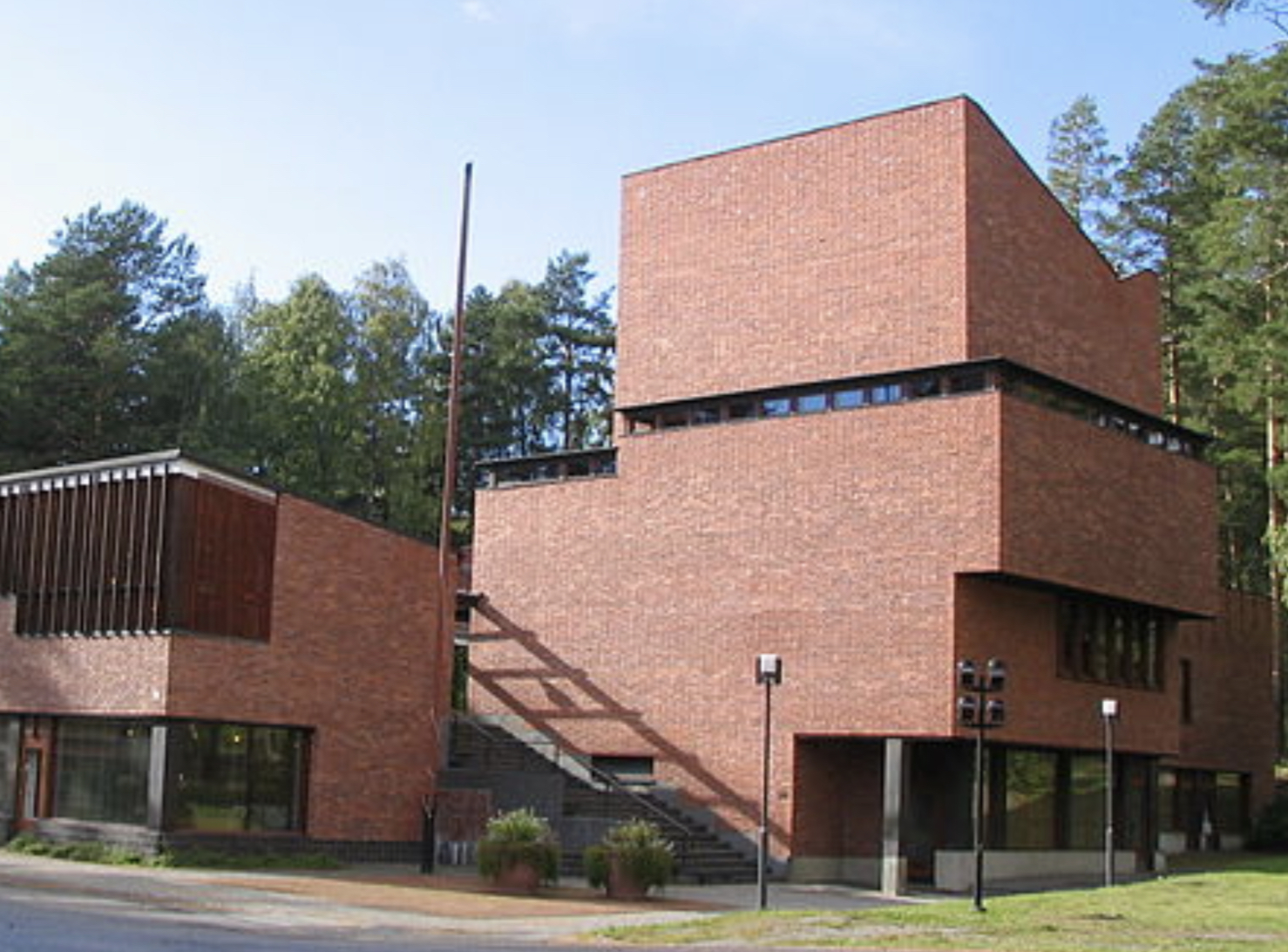
This article looks at one of his most famous buildings, The Town Hall at Saynatsalo. It has long been described as an eclectic mix of vernacular forms assembled intuitively by the artist. Organic is another term frequently used yet there is a underlying geometric map showing that Aalto was very ordered in his expression of the organic.
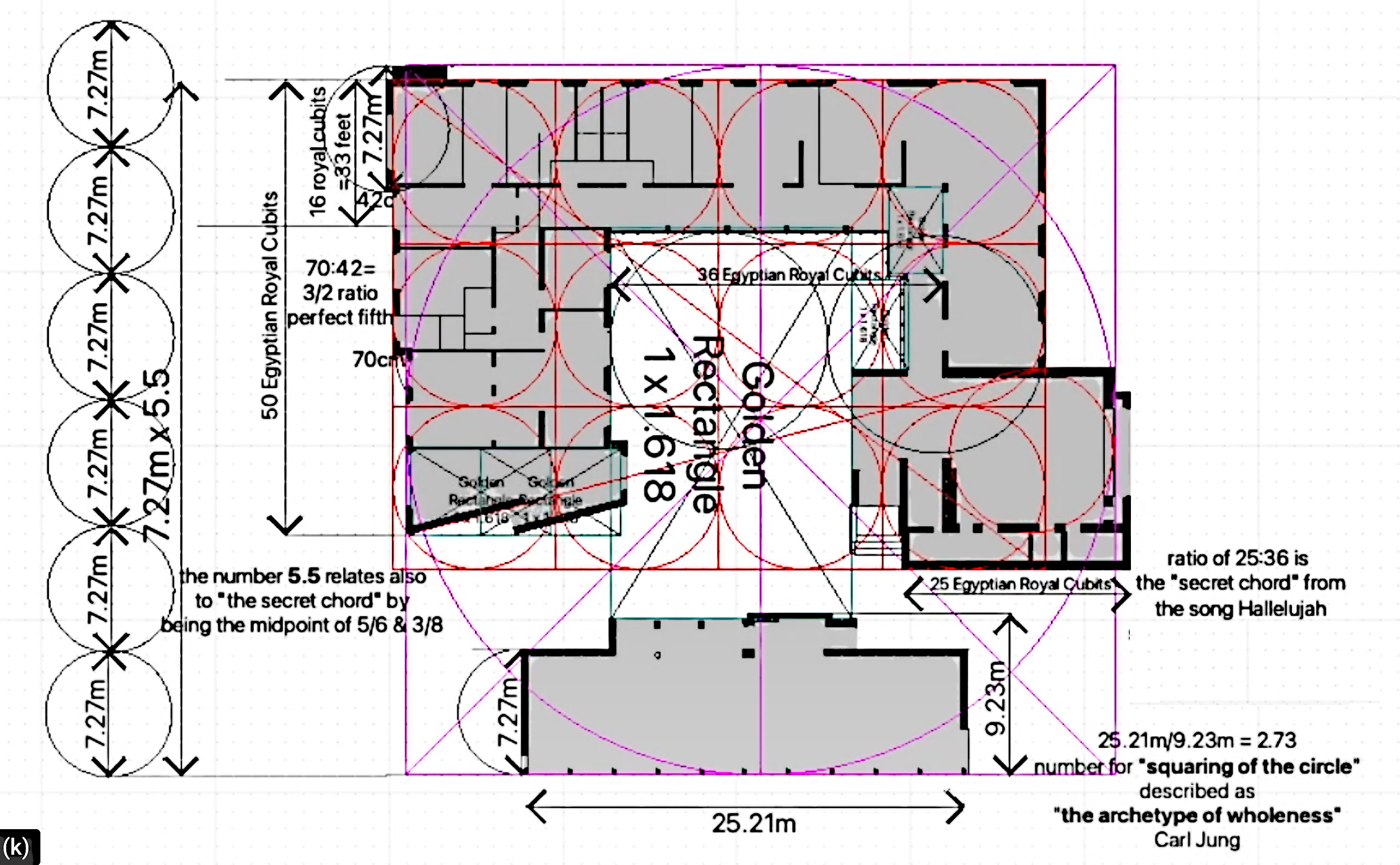
The floor plan below of Saynatsalo has been redrawn using the precise dimensions from his original drawings and lays bare the detailed geometrical structure setting out what for many has always been a random intuitive form.
His elevations likewise hold a similar detailed geometric structure. In this article we will focus on the Cantilevers. Here Aalto presents a ratio of 5:6 in the heights of the first two floors.
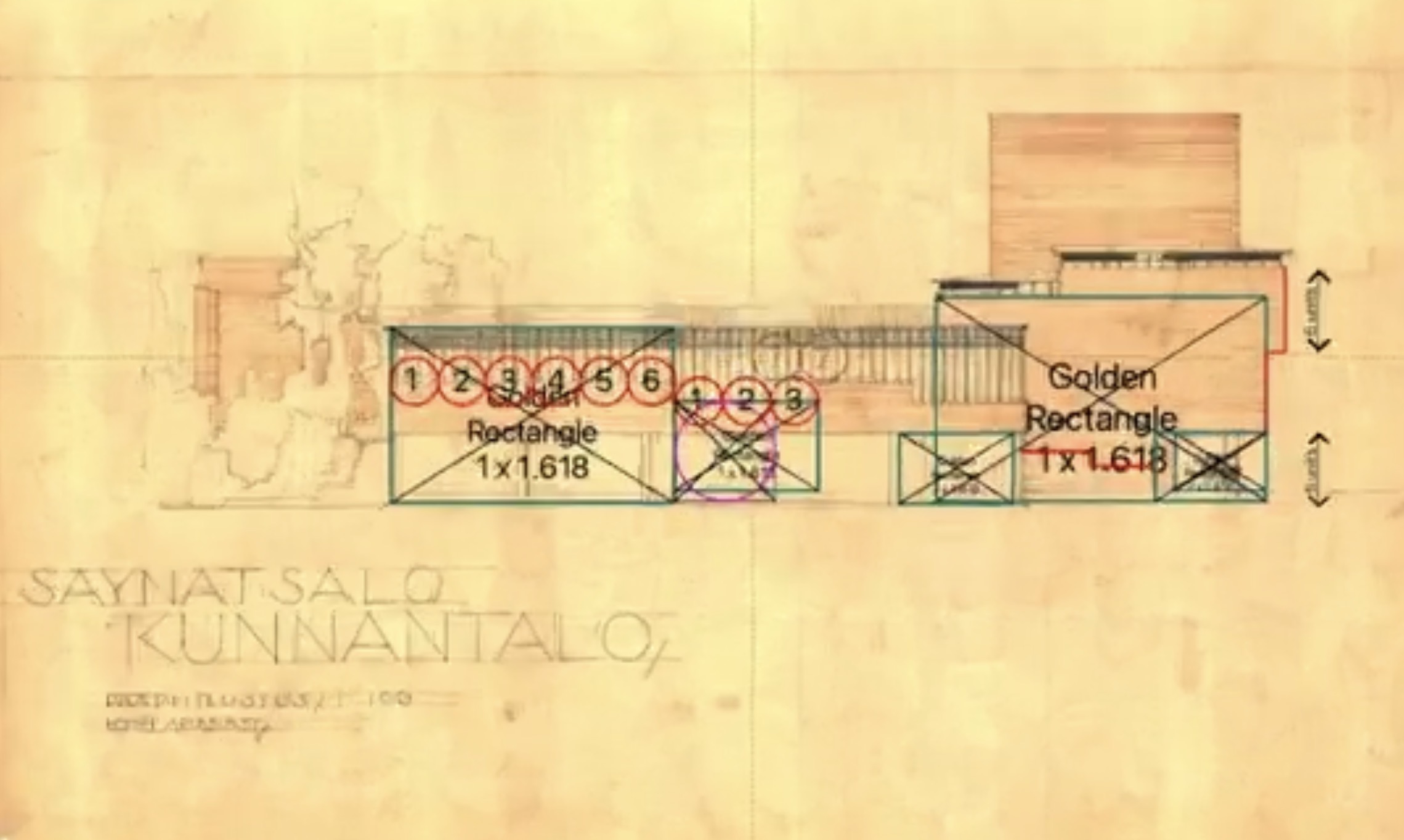
At first sight this may not seem anything unusual except that this ratio shows up in Buildings continually from Antiquity through to the modern day. 5/6 should be seen in unison with 3/8 (5/6 = .833) as they are both, along with 4/7, all related to the famous “Secret Chord” from the song Hallelujah.
About 10 years ago, a researcher Eric Rankin, discovered that the sum of the internal angles of the first five Platonic shapes in 2D all equate to frequencies in Pythagorean Tuning. As an example,
triangle = (3 x 60 degrees ) = 180 degrees/Hz = F#
Octagon = (8 x 135 degrees) = 1080 degrees/Hz = C#
F# to C# is a Major 5th and C# down to F# is a minor 4th. It is not so much a chord, more of a progression.
In addition to the extensive use of the golden rectangle Aalto is introducing a fourth dimension. He rotates the cantilever 90 degrees counter clockwise and reduces it to 80% of the original size. Although it may not be as Aalto interpreted this function, it relates to something mathematicians call Complex Numbers which are 4th dimensional.
Looking deeper Aalto uses Harmonic ratios throughout the plan. One of the most interesting is the stepping on of the building on the West Elevation. The dimensions of the narrow strip of wall are 42cm and 70cm. This ratio is
(6 x 7) : (10 x 7) or 3:5
There is no apparent reason for doing this on the elevations and only loosely relates to the internal walls on the plan. It does however set the boundary condition for the larger 3:4 rectangle (or 345) differentiating it from the primary square that the whole building is set out to. It may also be a combination of the 3:5 being a sixth in music and the 345 triangle representing a fifth where the length of the diagonal of 5 is the key component. This has to do with defining the largest allowable wavelength within the geometry.
Architecture has long been suggested to be frozen music but looking at the detailed mathematical, geometric and musical structure here it seems more to be a continuous hum. This analysis has been about Aalto but others also know the code and are quietly incorporating it into their projects.